Mastering Subscription Fatigue: Taking Back Your Cash Flow
Published on May 11, 2026 Updated
Last Friday night, I ordered dinner, sat on my couch, and turned on my TV. I opened Netflix. I scrolled through the trending section, added a few things to my watchlist, but didn't click play. Then I opened Amazon Prime. Scrolled for another 10 minutes. Then I checked Disney+ Hotstar. By the time my food was cold, 45 minutes had passed, and I hadn't watched a single second of a movie. I was exhausted just from trying to make a choice. I ended up watching a 10-year-old YouTube video on my phone while I ate.
It was a ridiculous situation, but it highlighted a massive modern problem. I was paying roughly ₹2,000 a month to have access to millions of hours of premium content, and my brain was completely paralyzed by the sheer volume of it. This isn't just a financial problem; this is Subscription Fatigue.
The Paradox of Choice
Psychologists call this phenomenon the "Paradox of Choice." When human beings are presented with two or three options, we make a decision quickly and are generally satisfied with it. When we are presented with 10,000 options, our brains short-circuit. We become terrified of making the "wrong" choice, so we make no choice at all.
Tech companies know this. They aren't selling you content anymore; they are selling you the illusion of infinite choice. They want you to feel like if you cancel your subscription, you are losing access to the entire world of entertainment or productivity. The fear of missing out (FOMO) is what keeps your credit card on file, even when you haven't used the service in weeks.
Weaponized Convenience
The modern economy is built on weaponized convenience. In the past, if you wanted a specific software tool to edit a video, you bought the CD-ROM for ₹5,000. You owned it forever. If you didn't use it for six months, it didn't matter. It was sitting on your hard drive.
Today, companies like Adobe and Microsoft have realized they can extract significantly more lifetime value from you by forcing you to "rent" the software for ₹999 a month. The convenience is that you always have the latest updates. The weaponization is that the moment you stop paying, you lose access to all your previous work. You become a hostage to the subscription.
This model has bled into everything: meal kits, shaving razors, fitness apps, car washes, and even heated seats in some modern luxury cars. If you don't actively fight back, your entire monthly salary will be pre-allocated to corporations before it even hits your bank account.
The "One In, One Out" Rule
I realized I needed to take back control of both my cash flow and my mental energy. I instituted a strict protocol for my digital life called the "One In, One Out" rule.
I set a hard limit: I am only allowed to have exactly two entertainment subscriptions active at any given time. If a new show comes out on SonyLIV that I desperately want to watch, I am allowed to subscribe to it. However, to do so, I MUST cancel either my Netflix or my Amazon Prime account first.
This rule forces me to make a conscious, mathematical decision. Is this new show worth losing access to my current library? 90% of the time, the answer is no, and I save the money. The 10% of the time I do switch, I actually watch the show because I intentionally paid for it.
How to Use the Subscription Tracker as a Monthly Ritual
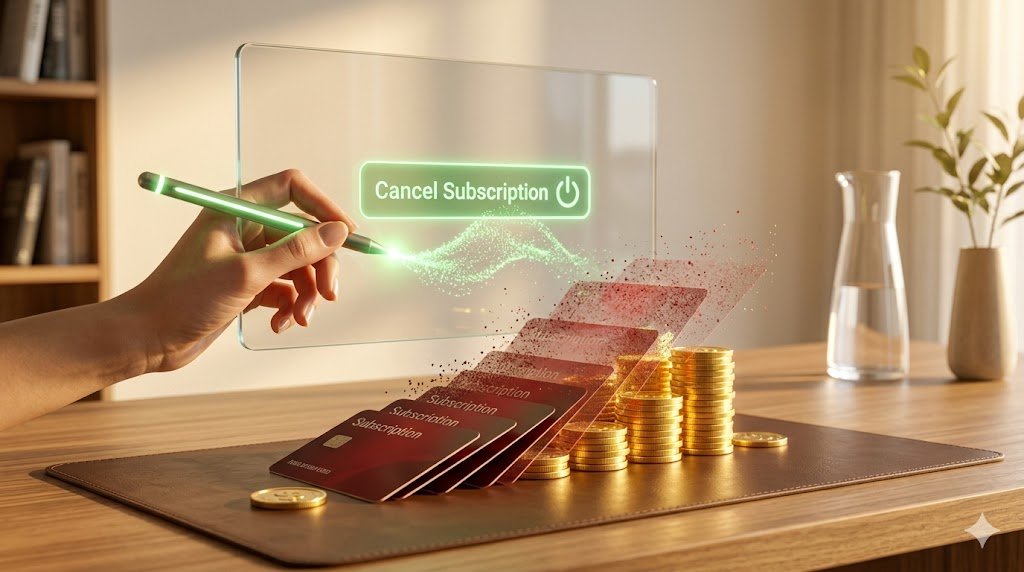
The only way to enforce these rules is to track the data. I use the Subscription Tracker on this site not just as a one-time audit, but as a monthly ritual.
- Set a Calendar Alert: On the 1st of every month, I have a recurring 15-minute meeting on my calendar titled "Cash Flow Defense."
- Open the Tracker: I look at the dashboard to see exactly what is scheduled to hit my credit card this month.
- Look for Bundles: I constantly look for ways to consolidate. Instead of paying for Spotify Music (₹119) and separate cloud storage (₹130), I moved to an Apple One bundle that gave me music, TV, and cloud storage for a slightly better overall value and, more importantly, reduced my mental clutter from two bills down to one.
- The Guillotine: If there is a service I didn't use in the previous 30 days, I click cancel. I don't pause it. I cancel it. If I desperately need it again in three months, I can always re-subscribe. It takes two minutes to re-activate.
Final Thoughts
Subscription fatigue is real, and it is a symptom of a much larger problem: we are letting corporations automate our financial decisions. Reclaim your agency. Make the choice to pay for things intentionally, rather than by default. When you reduce the clutter of infinite choices, the things you actually do choose to pay for become significantly more enjoyable.

Written by Rishav
Founder & Lead Developer
Rishav is an independent software developer and financial enthusiast based in India. He built CalculiX Pro to combat the cluttered, ad-heavy landscape of utility websites and provide users with privacy-first, instant mathematical answers. When not coding, he writes about personal finance, algorithmic logic, and web architecture.
Read more about the mission